








.jpg "Mountain, hiking and fitness safety rope for outdoor rock climbing sport protection with harness. Trekking adventure girl in nature with climber athlete gear for accident prevention in wilderness.")




4 Key Elements of Limit Bouldering Training


Climbing serves as a simple and highly effective method to develop strength and explosive power.
Although bouldering has become a common form of training, the concept of “limit bouldering” is particularly significant in a professional training context.
While the term “limit climbing” is widely used, not all high-difficulty climbing falls into this category.
Effective limit bouldering is distinctly different from general attempts, with its core lying in systematic and targeted effort.
The following four key principles can help enhance strength performance more effectively during limit bouldering training.
I. Limit Bouldering is Training, Not Ordinary Climbing
Climbing activities possess social, fluid, and low-psychological-threshold characteristics, allowing participants to complete multiple routes in a single session.
While these are strengths of climbing, limit bouldering requires greater focus. Not every climbing session is suitable for limit training.
The primary goal of limit bouldering is not to complete routes but to push the boundaries of strength, using high-intensity stimuli to promote strength gains.
Therefore, the chosen climbing moves should be at the edge of one’s personal ability—specifically, short 3 to 5-move sequences that demand maximum effort yet remain difficult to complete.
It is worth noting that the tall walls and long routes in modern climbing gyms may be more suitable for developing power endurance rather than pure strength.
Thus, limit training should focus on short, difficult sections, saving long routes for open climbing or endurance training sessions.
Alternative Suggestions:
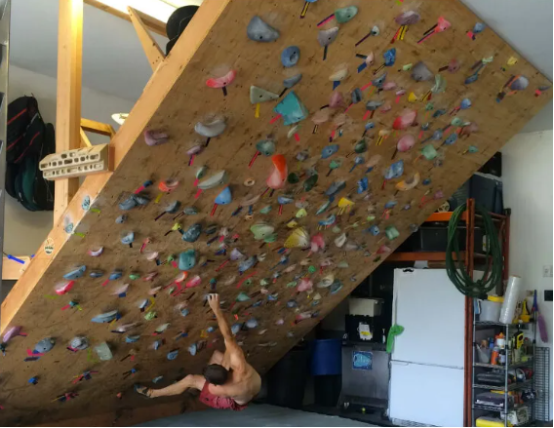
1. Segmenting Large Boulders: You can train on local, short sequences of a large boulder. Even if the overall difficulty far exceeds your current level, its segments may still provide appropriate strength stimuli.
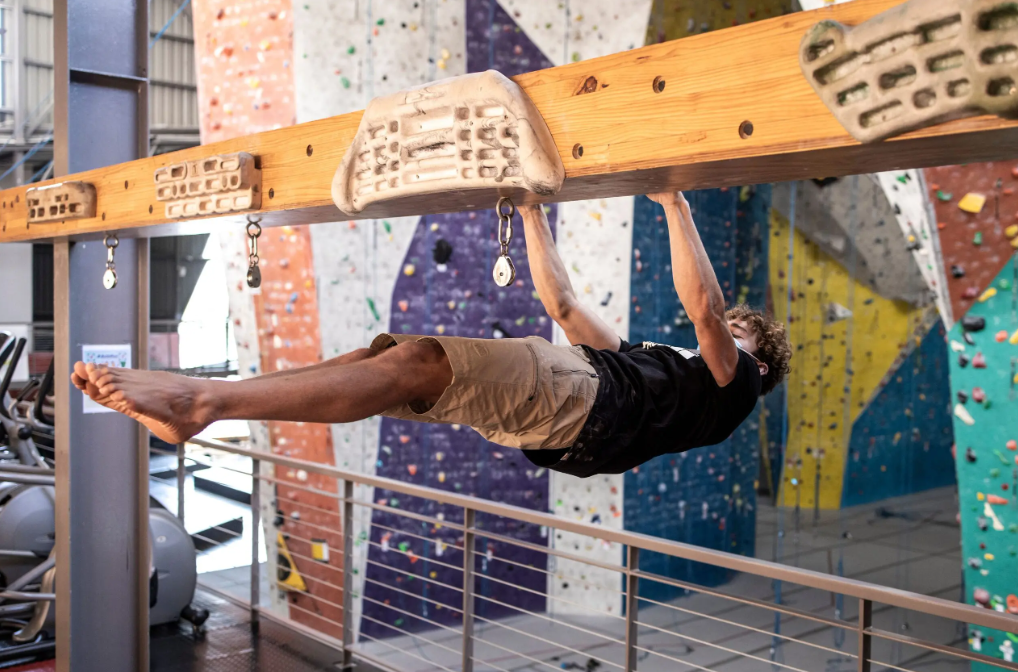
2. Using Training Boards: Steep wooden training boards like tension boards or moon boards, with their steep angles, poor holds, and short routes, are ideal for designing 3 to 5-move limit sequences.
II. Adequate Recovery: Take Off Your Shoes and Rest Between Attempts
Limit bouldering requires each attempt to be near maximum effort intensity, so adequate recovery must be scheduled between attempts.
A common issue is climbers resting insufficiently due to excitement or eagerness to try again.
A practical method is to take off your climbing shoes after each attempt. This action not only enforces rest but also helps build a subjective perception of recovery.
Recovery time depends on the intensity of the previous attempt: understanding the movement phase might require only a minute of rest, whereas a full-effort attempt may need five minutes or more.
Cultivating a bodily sense of “full recovery” and only attempting high-quality moves in this state is key to improving training effectiveness.
III. Conscious Technical Execution
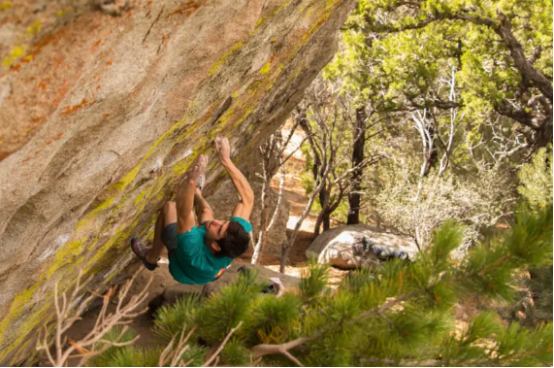
While following the principles above, climbers will experience frequent failure during limit training.
Failure itself indicates an appropriate difficulty level, but failure alone is not enough to bring progress.
During rest periods—for example, while shoes are off—movement should be reviewed:
- Was foot placement accurate?
- Was hand positioning optimal?
- Was the force production pattern optimized?
- Was breathing coordinated?
In a limit state, every detail can affect the outcome.
Cultivating conscious awareness of movement is crucial for all forms of climbing, and limit training is an ideal scenario to exercise this ability.
Feedback from climbing partners, coaching guidance, or video analysis is recommended.
IV. Prioritize Quality Over Quantity
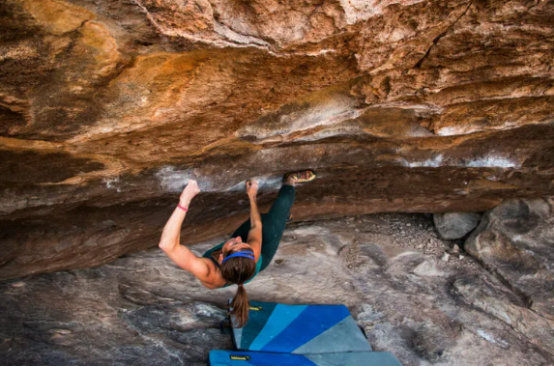
Limit bouldering aims for strength development, and strength training emphasizes quality over quantity. Strength cannot be effectively improved in a fatigued state.
This has two implications:
1. Full Recovery Before Training: It is advisable to schedule a rest day before a limit bouldering day to ensure the body is in optimal condition.
If climbing or other training was done the previous day, it may be more suitable for technique practice, endurance training, or complete rest.
2. Avoid Training to Failure: Limit training should not lead to extreme fatigue or grip exhaustion.
High-quality maximum-effort attempts are far more effective for strength gains than numerous moderate-intensity attempts.
Once strength begins to decline, training should stop, resuming only after full recovery.
Conclusion
Although climbing and bouldering training encompass more dimensions, adhering to the four principles above will help enhance strength levels more systematically and efficiently. As a specialized training method, limit bouldering emphasizes intensity, recovery, awareness, and quality, making it suitable for climbers seeking to break through strength plateaus.