




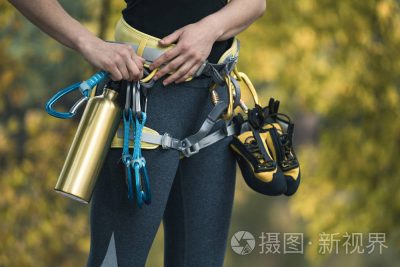
.jpg "Mountain, hiking and fitness safety rope for outdoor rock climbing sport protection with harness. Trekking adventure girl in nature with climber athlete gear for accident prevention in wilderness.")
How to choose the right Carabiners?

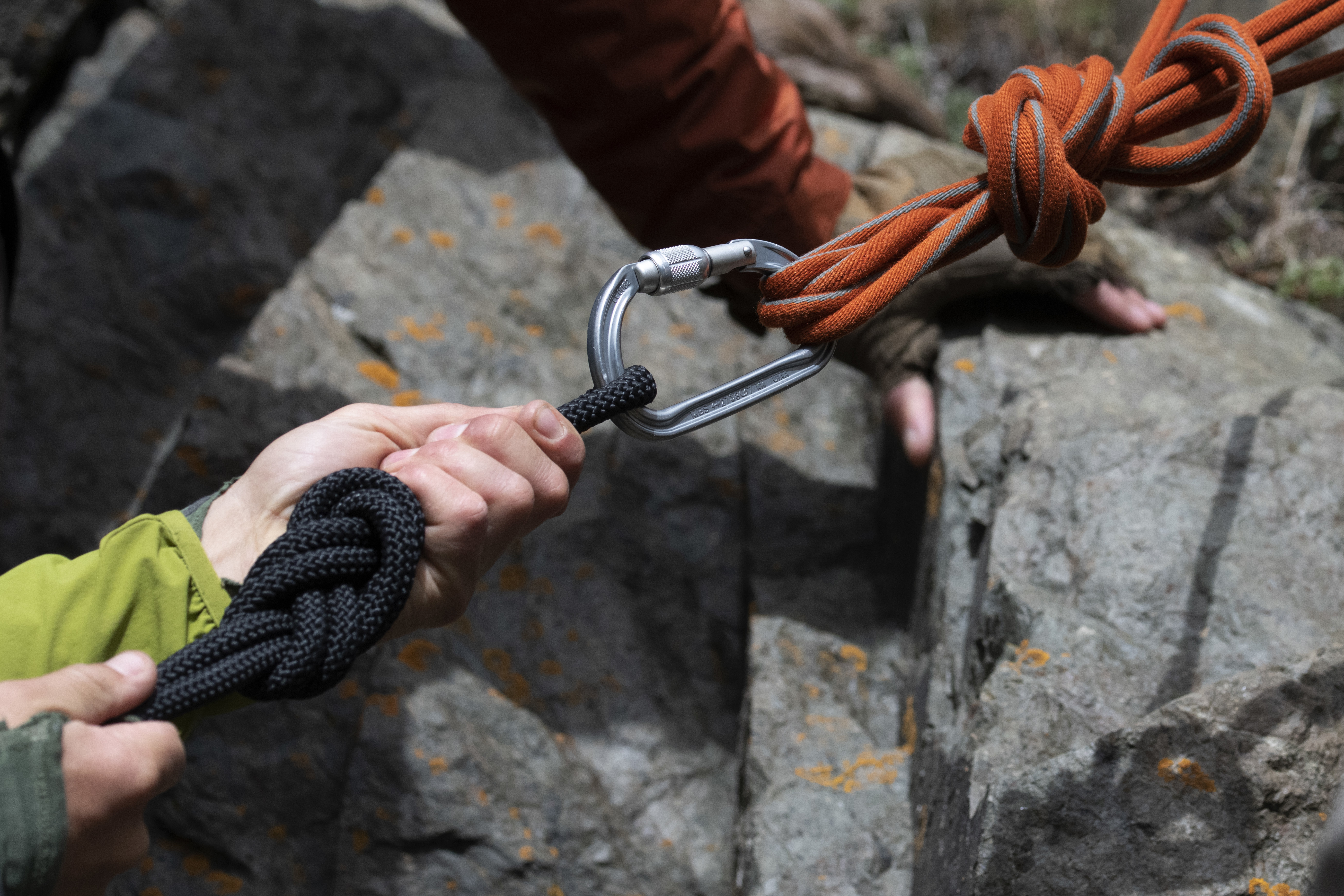
Just like with any other task, using the right tool for the job is the most cost-effective approach.
You will benefit from choosing the correct carabiner for your type of climbing. While any certified carabiner can be used for multiple purposes, like most climbing tools, they are designed for specific applications.
Even within the realms of rock climbing and mountaineering, how do you know what style or type of carabiner to choose? How can people determine which carabiner they need? As gear users, we possess a deep understanding of equipment. Here, we provide a systematic introduction.
I. About Carabiner Strength
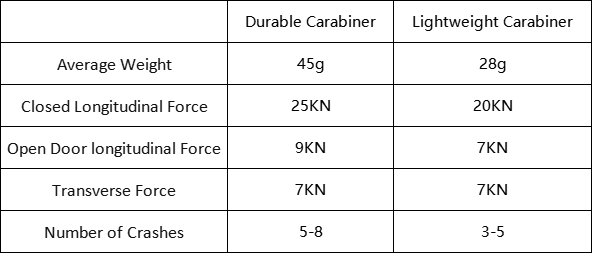
There are subtle differences in the details between different types of carabiners. For discussion purposes, the minimum strength requirements most climbing carabiners must meet are:
- Closed Gate Strength: 20 KN
- Open Gate Strength: 7 KN
- Minor Axis Strength: 7 KN
While theoretically a carabiner can be loaded to 20 kN, this is extremely rare and usually the result of errors.
Is a 24 kN carabiner stronger than a 20 kN one? Yes. Is it important? In most cases, no.
The longitudinal strength with the gate open and the transverse strength with the gate closed are approximately one-third of the longitudinal strength with the gate closed. Both scenarios can occur in practice.
Therefore, it’s not a bad thing if the open-gate longitudinal strength and cross-loaded closed-gate strength are higher. However, it must be reiterated that all carabiners sold normally meet the minimum (CE) requirements.
II. Choosing the Right Carabiner for Your Climbing
1.Belay Carabiners
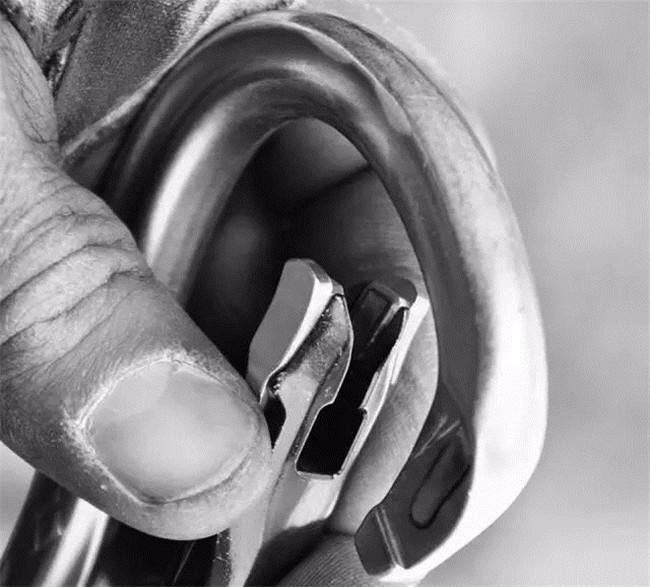
Belay carabiners, widely known as HMS carabiners (pear-shaped screwgates).
There are heavy-duty and lightweight versions. Heavy-duty versions are typically made from large-diameter wire stock. Lightweight versions are often made using more advanced I-beam construction, where key material sections are optimized to critical values, removing unnecessary material to develop lighter carabiners.
Large-diameter carabiners generally last longer, and large rope surfaces pass over them smoothly. Lightweight I-beam carabiners often allow faster rope movement (due to geometric differences).
For me, I tend to prefer Rock Lock or Mini Pear carabiners for belaying. Grid Lock requires a belay carabiner. Vapor Lock is suitable for multi-pitch climbing, ice climbing, or alpine climbing.
2.Carabiners (General Use)
In today’s market, there are several different types of gate-locking mechanisms:
- Screw Gate: Threaded sleeve lock.
- Twist Lock: Auto-locking mechanism.
- Magnetron Lock: New magnetic auto-locking mechanism.
Twist Lock and Magnetron Lock are auto-locking carabiners. When the gate closes, the mechanism automatically engages and locks. Conversely, screwgate carabiners require manual twisting to lock.
Screwgates are significantly lighter than auto-locking carabiners.
Now, you need to choose between “lighter” and “safer” (convenience).
Alongside the different locking mechanisms, carabiners can also be broadly categorized into two types: large and small.
Typical large carabiners are commonly used for belaying, setting up top ropes, or as the primary load point in an anchor.
Small carabiners are typically used for clipping into protection points (where open-gate scenarios must be considered), building anchors in specific placements, or connecting the climber to protection.
3.Wire Gate vs. Solid Gate
Wire gate carabiners offer advantages like lightweight construction and freeze resistance. The reduced mass also effectively helps prevent the gate from being “bounced” open due to shock loads generated during a fall.
During a climbing fall, the carabiner experiences impact forces. The rope stretches and then tightens, creating significant oscillation.
Traditional solid gate carabiners have more mass at the gate. During oscillation and vibration, this mass can cause the gate to open slightly, potentially leading to the carabiner being loaded with the gate open.
As mentioned earlier, the load strength with the gate closed is 3 to 4 times higher than when open. Wire gates, with their reduced mass, effectively minimize this risk.
Personally, I appreciate the “lightweight” and “freeze-resistant” qualities of wire gates. Therefore, I recommend them for long routes, ice climbing, or alpine climbing.
4.Keylock Nose vs. Traditional Notched Nose
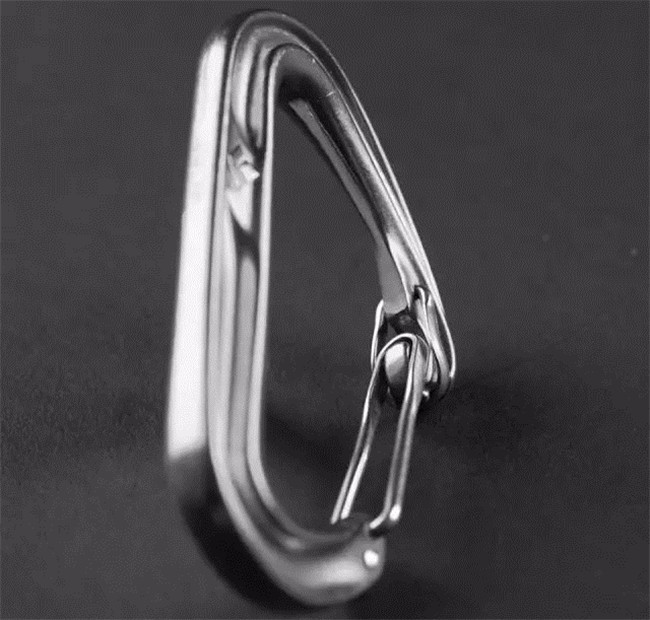
Traditional carabiner gates use a “hook and pin” (notched nose and pin) structure to connect the gate to the spine and bear the load when closed.
This design is stable, robust, easy to manufacture, and cost-effective.
Another reliable gate design, the keylock nose system, emerged a few years ago.
This system uses a specially shaped hole at the gate interface and a smooth, notch-free nose shape. When the gate closes, the load is borne without any protruding notch.
The advantage of this design is that it significantly reduces snagging on objects like bolt hangers, nut wires, and slings, which could prevent the carabiner from being loaded correctly.
Snagging can dramatically reduce the carabiner’s effective strength and is one of the most common causes of carabiner failure.
Manufacturing carabiners with a keylock nose system is more expensive, but you benefit from a snag-free carabiner.
So far, if you truly like the snag-free design of keylock but desire the lighter weight and anti-bounce characteristics of a wire gate, you have had to choose one or the other (until hybrid options emerged).
5.Heavy vs. Light
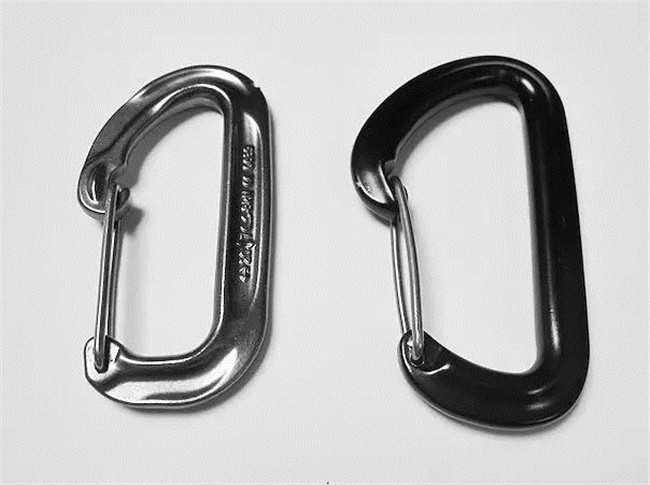
1) Is lighter equipment always better for sport climbing?
Absolutely, if you’re tackling a long multi-pitch route in the Canadian Rockies, or a difficult route requiring 22 quickdraws, choose lightweight gear!
However, if what you need are quickdraws for projecting hard sport routes where they will take frequent, hard falls, the lightest option might not be optimal.
2) Why?
To achieve lighter weight, some material is removed during manufacturing. While the final product meets CE requirements, less material means:
- Smaller size makes them harder to clip.
- Reduced material on the spine makes it more prone to bending/deformation under load.
- Reduced material on the rope-bearing surface can lead to more violent rope movement during a fall.
For everyday sport climbing at the crag, an appropriate quickdraw typically has a snag-free carabiner on the top end (to prevent nose-hooking on bolt hangers) and a large carabiner on the bottom end (for easy rope clipping).
Examples designed for sport climbing include the Live Wire, Nitron, or Hood Wire quickdraws.
3) We conducted comparative drop tests on the test tower using durable carabiners and lightweight carabiners from several manufacturers. The goal was to determine how many Factor 1.7 falls, caught with a completely static belay (no rope feed whatsoever during arrest), it took to damage the rope or destroy the carabiner.
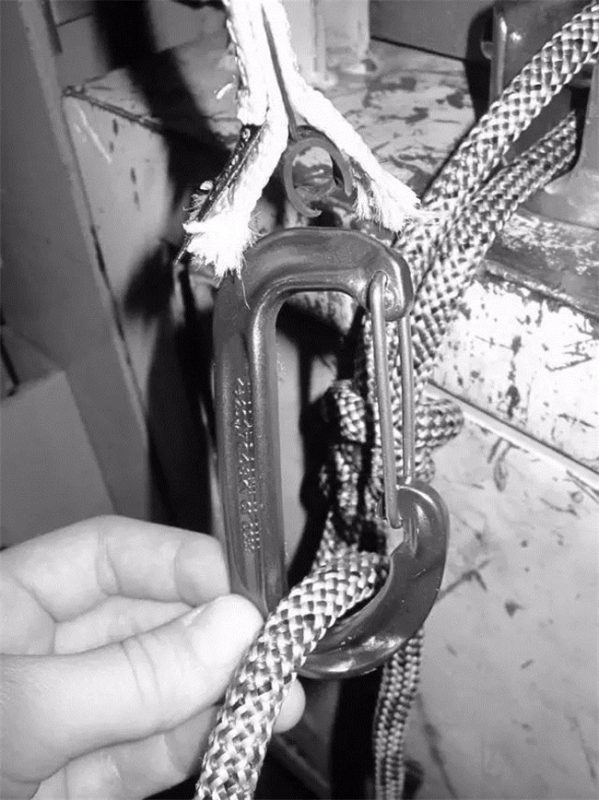
- Durable Carabiners: Rope cut; Carabiner functional.
- Lightweight Carabiners: Sling cut; Carabiner deformed.
For most larger, heavier carabiners, the rope was usually cut while the carabiner remained largely undamaged and usable for climbing. However, after 3 to 5 falls, lightweight, small carabiners were often severely deformed to the point where I considered them functionally compromised (e.g., gate couldn’t open). In rare cases, the 10mm Dynex sling was cut.
Clearly, this test is extremely severe – no one normally takes repeated Factor 1.7 falls onto the same spot on the rope with a completely static belay. Nevertheless, it showed that lightweight carabiners are relatively more susceptible to damage.
4) Conclusion
What do these tests imply? Use the right gear for the climb. Heavy carabiners have larger cross-sections, making them stronger and more resistant to wear. For carabiners on quickdraws used for projecting sport routes, which will likely endure frequent falls, larger, heavier carabiners are more appropriate.
Small, lightweight carabiners are not primarily designed for enduring such frequent, high-impact use. They are more suitable where the weight of carried equipment is the paramount factor, such as in alpine-style technical mountaineering or ice climbing.
Lightweight gear will make you faster on alpine routes. Durable sport climbing carabiners will give your gear a longer lifespan.